

DRIP SPLATTER SMEAR
Research and Development Project
My Work and Practice
I am an Isle of Wight based artist whose work focuses on tactile mark-making. Working directly with my hands on glass and paper, I create layered abstract pieces shaped by music, movement and emotion. My process combines immediate, physical mark-making with a careful editing stage, where I scrape back, refine and restructure each composition. Light, transparency and shadow are key elements, particularly in my glass works, where layered marks create shifting, three-dimensional forms. This balance of physical energy and thoughtful construction underpins my practice and drives my ongoing exploration of abstraction.
Alongside my studio practice, I work with communities through co-produced public art projects that often explore literal, nature-based themes. These projects focus on storytelling, environment and place-making, allowing participants to guide ideas and develop creative confidence. While this work has been hugely rewarding, it has also highlighted my desire to bring more of my abstract, hands-on techniques into community settings, as this is where my greatest passion and energy lie – and where feedback from a number of pilot abstract workshops has been really positive.
My Drip Splatter Smear research and development project explores and develops this shift, creating opportunities to try out new materials and new processes that can open up abstract mark-making as a supportive, expressive experience for a wider range of people, and to connect with new communities and organisations on and off the Isle of Wight.


DRIP SPLATTER SMEAR
Free Pilot Workshop Responses
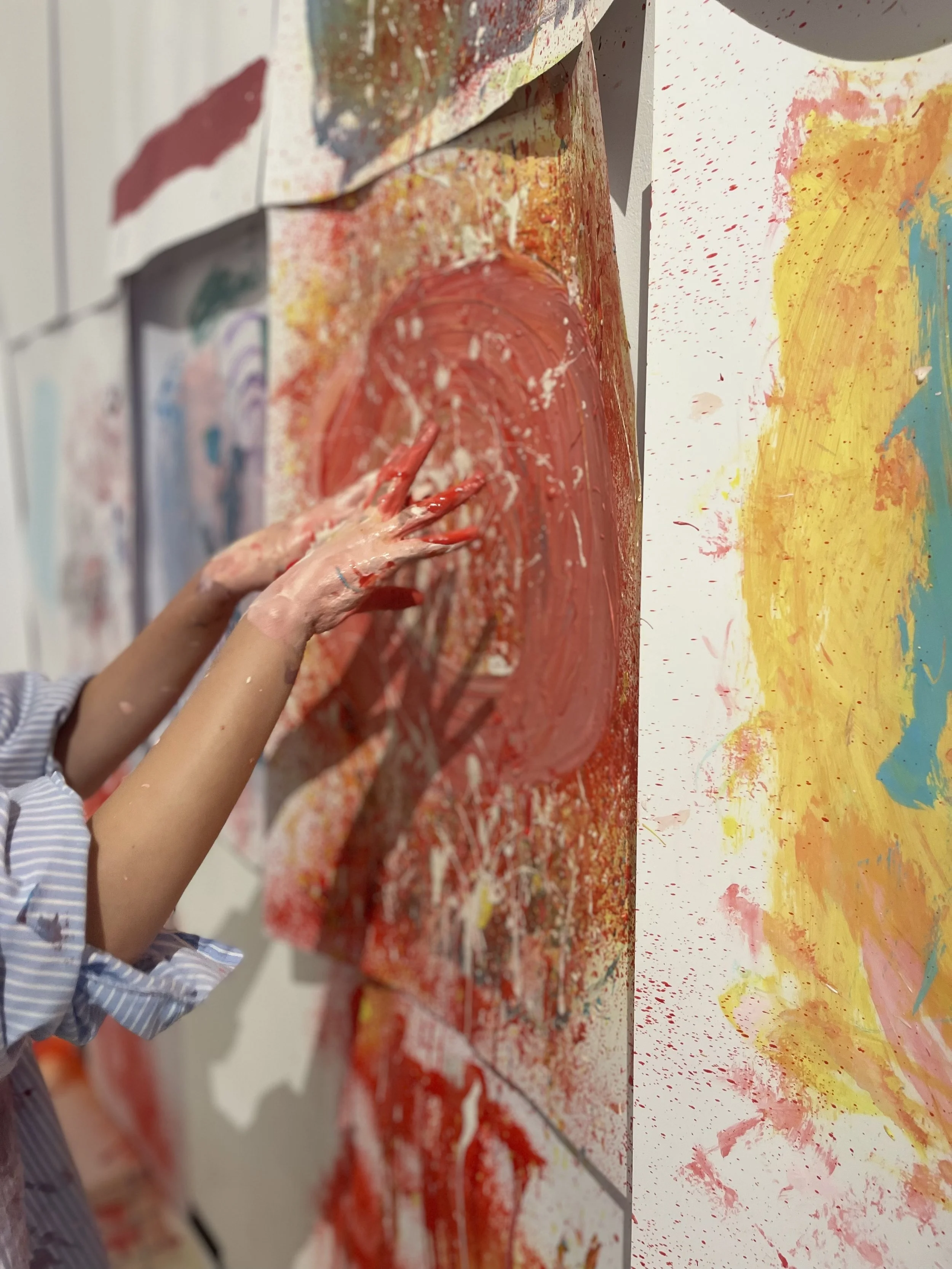
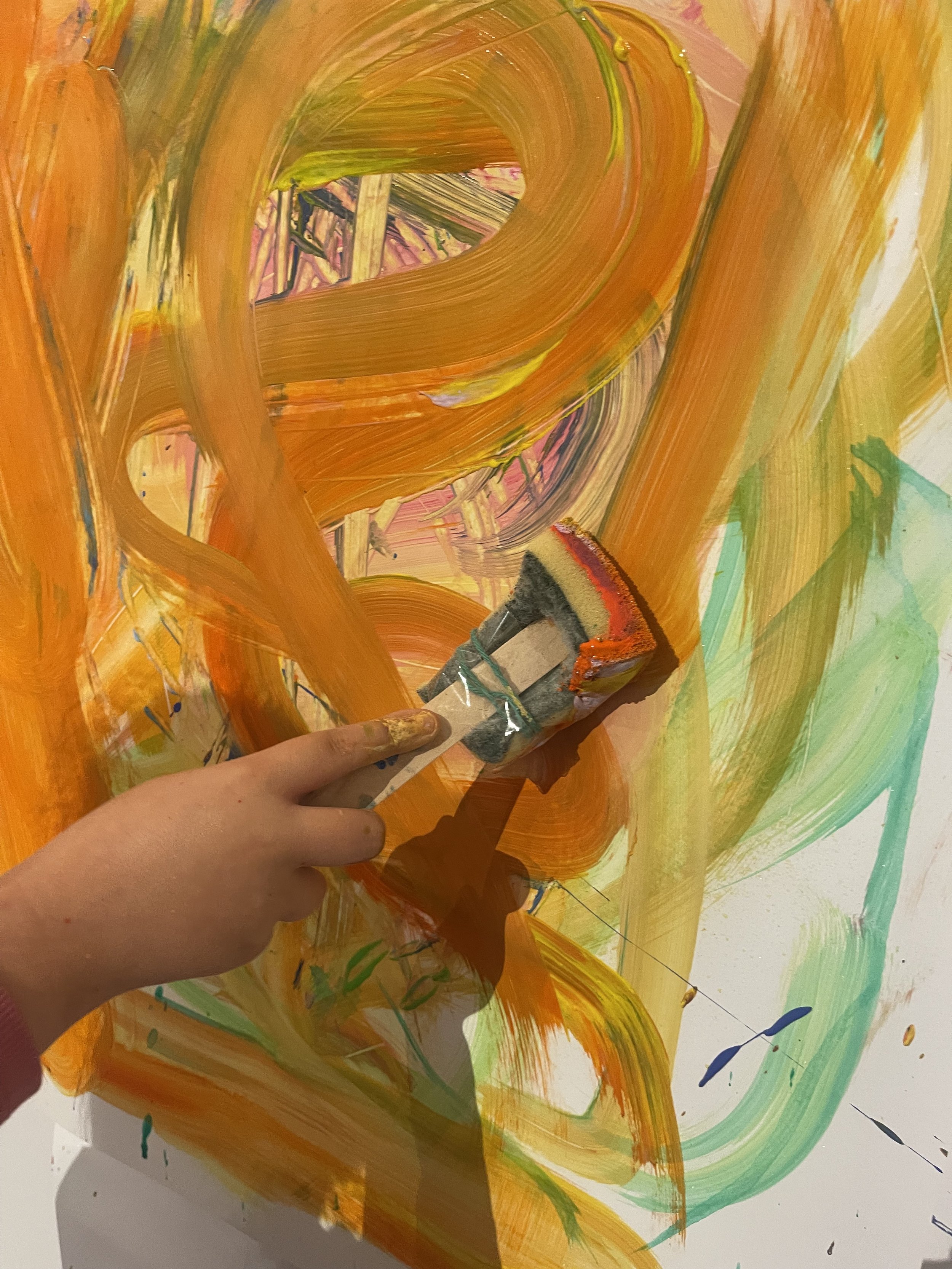
In Summer 2024 I developed and delivered a series of pilot abstract workshops during my solo exhibition and residency Drip Splatter Smear. I invited children, young people and adults to experiment with abstract mark-making using everyday objects like spray bottles, water balloons, throw-away household items: cardboard, packaging, sponges alongside collected natural materials and also their hands. These sessions tested how my own tactile, expressive studio processes could be translated into accessible, playful workshops that support wellbeing in community settings. The pilots created a safe space for people to get messy, work together and explore emotion through paint rather than words and the feedback was overwhelmingly positive.
It is with this ethos in mind that I now want to develop new ways of working with the Drip Splatter Smear concept, experimenting with new materials and new ideas that more directly link my own abstract practice with accessible experiences for the community. By trying out new approaches, surfaces and structures, my aim is to create future workshops and installations that allow others to benefit in the same way I do from playful, embodied mark-making with paint.
Below are some of the things participants said about their experience in the pilot workshops.

-
What did you enjoy most about painting?
“Making the tools.”
“The painting part of all we did.”
“Throwing paint at the wall.”
“Drawing art with friends.”
“Being in the “Make your Mark” room.”
“It was fun.”
“It made me happy.”
“Making a mess.”
“Just being able to splatter paint wherever but not having to worry if anything got dirty.”
“Flicking.”
“Unleashing the inner child.”
“I felt happy and enjoyed ficking the paint.”
-
Did you like using different and unusual things to paint with? Which was the most fun?
“Yes the rollers.”
“Yes making mess.”
“The little balls one was the most fun.”
“Yes I loved the spray.”
“Yes the spray bottles.”
“The water balloon.”
“I really enjoyed painting using a piece of cardboard, a wooden spoon, and a stick. It gives wonderful textures and helps loosen up.”
“Painting with hands and experimenting with different ideas.”
“There was a great assortment of different materials to choose from. I particularly enjoyed using the spray bottles.”
“My hands and flicking.”
“It was a wonderful experience, exploring different textures, to work with.”
-
How did making abstract art make you feel?
“Enjoyable.”
“Happy calm.”
“Like I can enjoy it.”
“Happy.”
“Calm.”
“Great.”
“Making abstract art gives you more freedom, as there is no particular expectation how your art will turn up. You can be creative without worrying about the end result.”
“Happy and relaxed.”
“Creative and satisfying. It was good to express free movement.”
“Silly and happy and bouncy.”
“Joyful.”
-
Would you like to get messy with paint again?
“Yes.”
“Yes of course.”
“Yes.”
“Yes.”
“Yes but in different clothes.”
“YES.”
“I would love to!”
“Yes.”
“Yes definitely.”
“Yes!!!!!!!”
“It was a great form of therapy – great way to be present.”



Connecting Abstract Practice and Public Engagement Through Material Research and Development
As part of this Research & Development project, I want to explore a new strand of my abstract practice: how painted surfaces can become sculptural, interactive objects for future public projects.
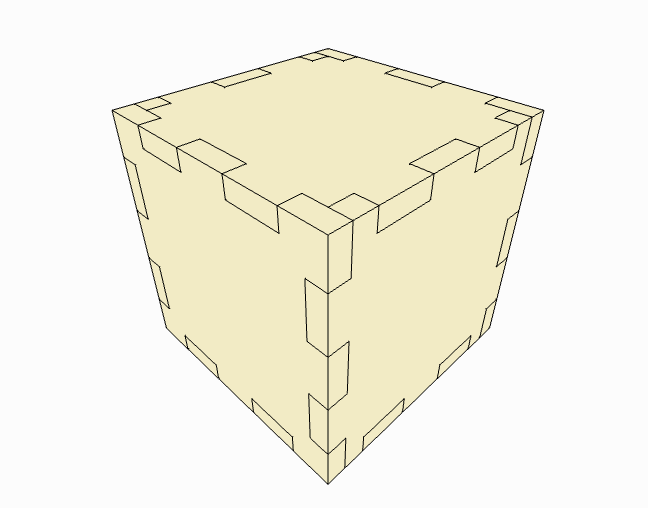
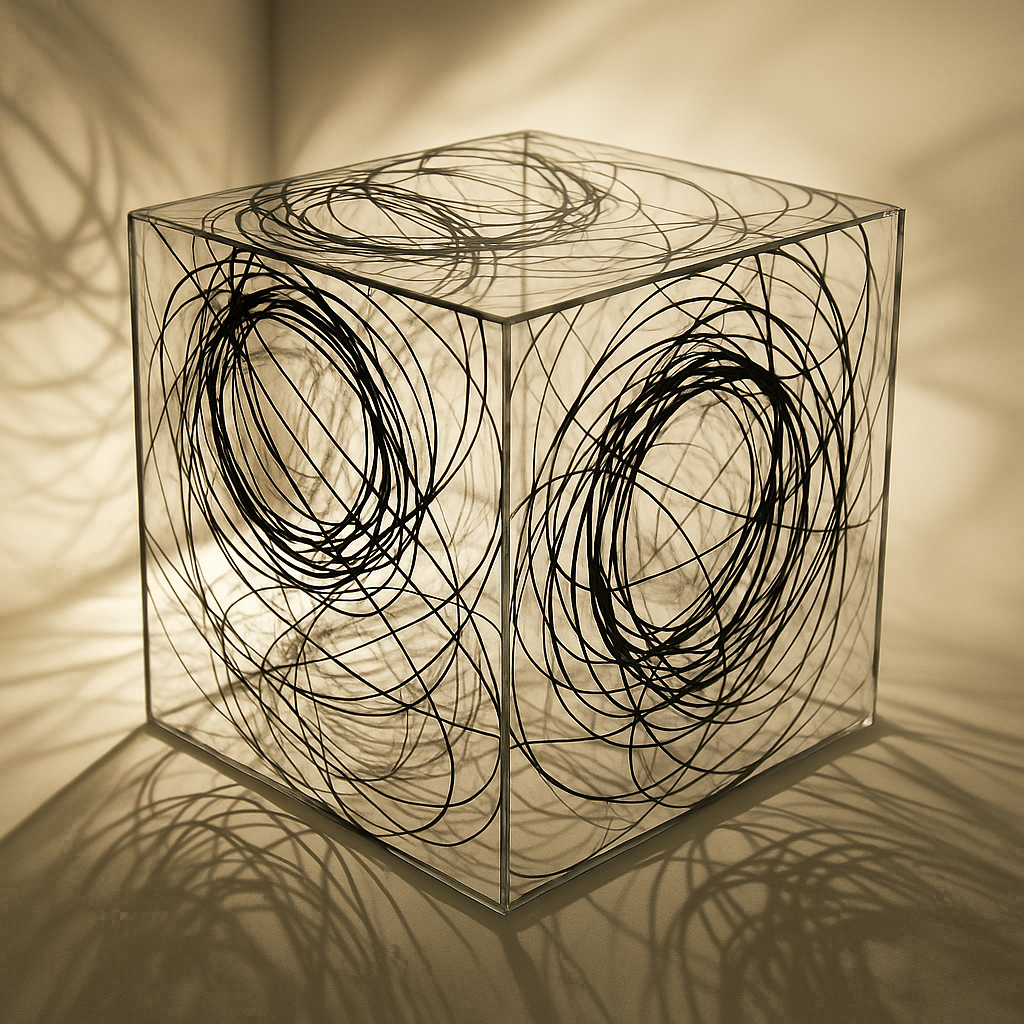
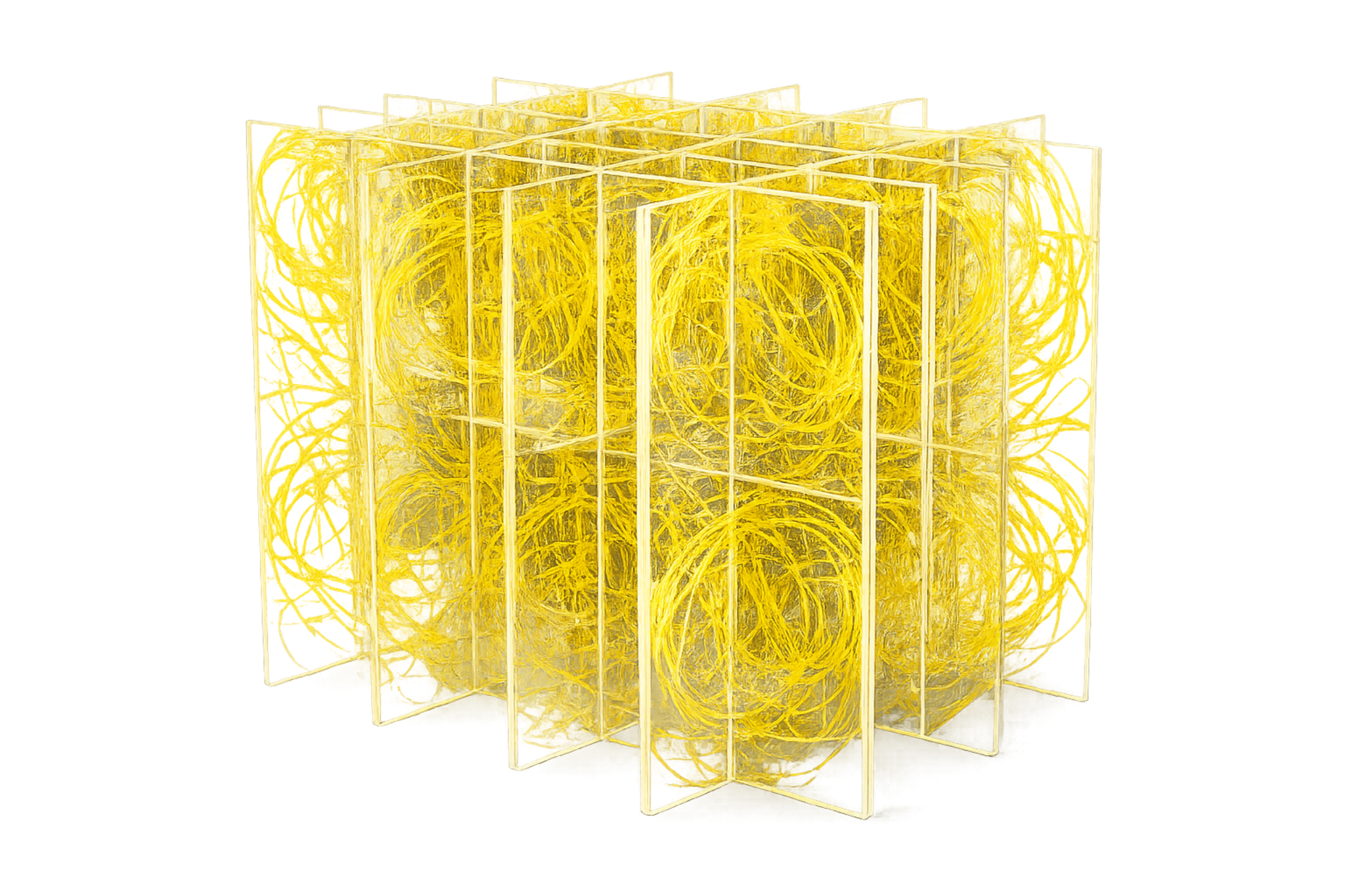
I will be working closely with Kreative Studios, a design and fabrication workshop based on the Isle of Wight, to experiment with laser-cut acrylic, card and plywood. Together, we will prototype modular, jigsaw-like components that slot together to form 3D cubes and structures. Each panel will act as a surface for abstract mark-making, both my own and, eventually, those created in workshops, allowing layered marks and gestures to be assembled into playful sculptural forms.
Development with Kreative Studios:
Testing acrylic surfaces and material behaviour
Experimenting with matte, frosted, clear and tinted acrylic, large format card, ply.
Exploring how different finishes affect light, shadow and visibility of painted marks.
Testing how different types of paint, pens, inks behave on different laser-cut materials, including variations in thickness, transparency and durability.
Using the laser cutter as an extension of my mark-making
Using etched lines, textures and patterns as part of the artwork itself.
Combining hand-painted gestures with precision-etched details to see how the two languages interact.
Exploring how abstract marks behave when cut into shapes rather than remaining on flat surfaces.
Developing prototypes of modular structures and joint systems
Trialling different joints and connectors
Flat jigsaw-like puzzles that assemble into sculptural reliefs, 3D cubes and modular blocks.
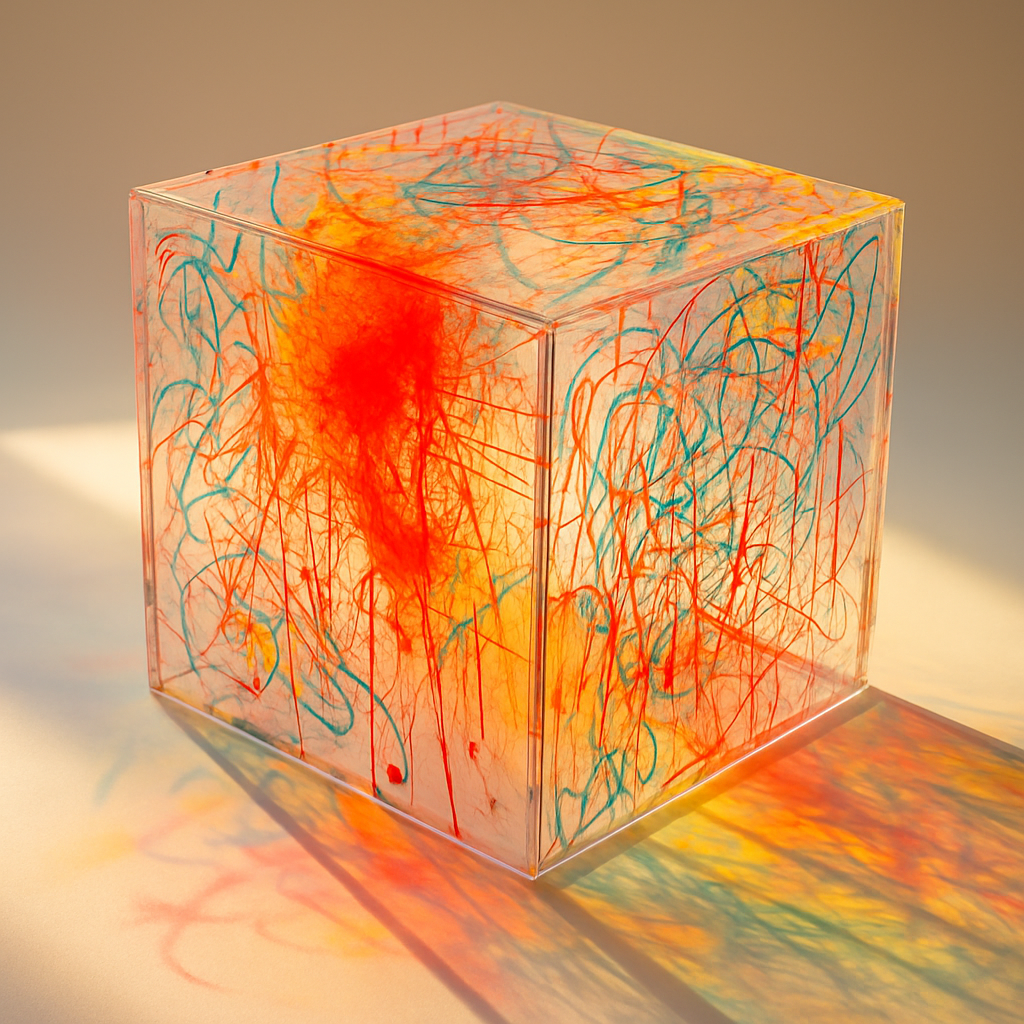
Exploring hybrid structures that layer painted paper behind acrylic panels for added depth and texture.
Exploring shadow, light and translucency
Experimenting with integrated lighting to explore shadow, transparency and movement.
Testing how painted marks appear when lit internally, backlit or side lit.
Considering how the public might reposition lit components to change the artwork dynamically.
Testing durability and suitability for public use
Running stress tests on connectors, surface finishes and paint durability.
Understanding how repeated assembly/disassembly affects the materials.
Exploring which systems are strong, safe and intuitive for the public to assemble.
At this stage, the emphasis is on pure experimentation, prototyping, testing and learning, so that I can build a new toolkit of materials and forms that do not yet exist in my practice. Longer term, these modular cubes and components could be painted, drawn on, layered, built and re-built by participants, becoming collaborative sculptures that carry many people’s marks. They offer a new way for communities to engage with abstraction: through touch, assembly, play and co-creation.
Working with Kreative Studios gives me access to technical skills, machinery and fabrication processes that I cannot access alone. Their support will be central to understanding what is structurally possible, how designs can evolve, and how this new material language could eventually support future workshops, commissions and public installations.
Digital Concept Maquettes
Connecting with New Organisations and Communities
A key part of this research and development project is to expand my connections with organisations, communities and audiences, both on and beyond the Isle of Wight. Working on the island can be creatively fulfilling, but it can also be isolating. Without funding, travelling to nearby cities like Portsmouth and Southampton, let alone further afield is difficult, which limits my ability to build relationships, collaborate, or stay connected with wider cultural activity.
Over the past few years, much of my work has been youth-led, which has been incredibly rewarding. I now want to build on this by connecting with a broader range of people: new groups of young people further afield, as well as new communities I haven’t yet had the chance to work with. For example, refugee and migrant groups, mothers and carers, men’s groups, older adults and people with disabilities and other access needs. I am interested in how abstract mark-making can be adapted to different lived experiences, access needs and cultural contexts.
This project will give me the time, support and financial access to meet new partners, visit organisations I haven’t had the opportunity to reach and connect with new networks I’ve been unable to engage with. I want to spend time visiting exhibitions, talks, studio spaces and community projects that will inspire new directions in my work and inform how I might share abstract mark-making more meaningfully with diverse groups.
Developing these connections is essential for the next stage of my practice. It will open doors to new collaborations, deepen my understanding of different community contexts, and help me build future participatory projects that are grounded, relevant and responsive. These research trips and conversations will play a vital role in shaping how my abstract work can evolve into new forms of public engagement and reach people who may not usually see themselves reflected in contemporary art.
These organisations represent a starting point for the off-Island connections I hope to make. They are only a small glimpse of the wider network I aim to discover, physically access and begin forming new partnerships with through this R&D.


Additional Research Trips and Flexible Travel Planning
As this R&D period unfolds, I expect the number of mainland research trips to increase in response to emerging opportunities. While my initial timeline shows key planned visits, I have intentionally built flexibility into the project through a Wightlink Multilink ferry pass, which allows additional lower-cost travel to Portsmouth, Southampton, London and further afield as new conversations, meetings and partnerships develop.
Because this project is exploratory, many connections will naturally develop during the R&D period, through sector research, invitations, follow-up meetings and networking. The travel budget ensures I can respond to these opportunities as they happen, rather than being restricted by fixed travel limits, enabling the project to grow in a meaningful and responsive way.
Community Feedback and Track Record
Peta Rainford, Artswork’s placemaking creative producer for the Isle of Wight, Gosport and Havant. Facilitating the ‘Young Cultural Change Makers’ and ‘Supporting Young Minds’ programme.
“I love working with Laura. There is quality and integrity in everything she does. She has been a fantastic collaborator in the youth-led projects we have worked on, being genuinely willing to listen to young people and allow creative freedom, whilst remaining true to her own practice. With her gentle approach, she creates a safe space for creative expression which supports the wellbeing of all those involved. Laura is a perfect fit for a youth-led project - she listens and ensures young people feel heard. Her approach is inclusive, engaging and highly responsive to the needs of the individuals and groups, providing structure where it's needed and space for creative freedom. She empowers young people to co-create professional-quality outcomes that make a difference to their communities, making them proud and boosting self-esteem and confidence.”
Ruth Hayles, Service lead for Exploitation and Youth Justice at Isle of Wight Council
“Laura you are always calm and considerate - you ensure children feel listened to and included in your sessions….you always include everyone's designs - however wild and out there, they might be. This makes children feel included and valued….projects always align with our ethos to give children Activities, Interactions and Roles that they wouldn't ordinarily have. You are supporting them to build prosocial identity through positive role modelling….The 'Child First' tenants are A - as children, B - build prosocial identity, C - collaborate with, D - divert from stigma; your work with children covers all of these, but particularly C - you always encourage children to incorporate their designs and ideas - allowing them to feel valued. Thankyou for all you do to support island children”.
Georgia Newman, Cultural Consultant and Creative Producer. Founder of the Isle of Wight Creave Network and Deputy Director for Creative Island – the development agency for culture on the Isle of Wight.
“Laura’s ability to draw inspiration from her surroundings, as seen in her recent large-scale community mural in Ryde, IW exemplifies her dedication to connecting with and reflecting local heritage. Beyond her own practice, Laura has made a profound impact through her extensive work with diverse communities - from her workshops for children and young adults to her creative sessions with rehabilitation centres and refugee projects.
It’s been wonderful to see her confidence grow, along with her artistic voice, which is always evolving. As a member of the Isle of Wight Creative Network, Laura is not only a talented artist but a generous contributor to our local creative ecosystem. I have no doubt her continued work will inspire many more to engage with art in new and meaningful ways”.
Kathy Whitewood, Head of Counselling & Wellbeing /MHST Lead
“We really enjoyed working with you Laura. Your creativity shone through, and was a real inspiration to our young people. You were calm, supportive, and encouraged the young people to bring their ideas to life.”
Blaire Maynard, Child Wellbeing Practitioner Youth & Community
"It was great from start to finish. Laura was patient and kind. The group was inclusive, engaging and Laura took her time to work with each YP, explaining different things. We loved it so much it over ran. The YP thoroughly enjoyed this, and it was great that the art they created, they got to take home. It enhanced the YP's creativity and self-expression with the pieces they created. It was great for their wellbeing getting to do something different than they usually would."

Dr Emma Blake, Consultant Child Mental Health and General Paediatrician, St Mary’s Hospital. Chair of the Isle of Wight NHS Youth Forum
“Laura was committed to this project and dedicated many hours to both developing the young people’s ideas and designs and getting the project done. She held sessions in the evenings and at weekends so the young people could attend. She encouraged all the young people – and got a lot out of those that are usually quieter and more reserved. She was always calm and encouraging and had a good sense of humour during the challenges (think terrible weather!!) Laura is clearly a skilled artist and carried the young people with her on the journey of transforming the Childrens Ward garden. She created a beautiful space with the young people that took into consideration young people with neurodiversity, sensory processing issues and those in mental health crisis. Laura listened to our young people and took note of the need to make a sustainable space that is good for the environment. Laura project managed the Garden transformation and worked closely with a number of people that included: Peta Rainford (Artswork), Becky Hepworth (Childrens Ward Matron), staff of Childrens ward, Estates Team, Rotary Club and of course the young people and other helpers.
Laura was always mindful that the space was a functioning Childrens Ward and the safety, safeguarding and security implications of that. I have had feedback from many young people (and other helpers) that they have really enjoyed working with Laura on this project over the last 8 months. She has made it fun and creative, listened to others’ ideas and found a collaborative, consensus way forward.
Laura has been a pleasure to work with on this project. It is artistically beautiful but also a well-designed therapeutic space for very vulnerable young patients. She has worked hard to make sure the project was co-produced with young people (and staff) from the very beginning giving everyone a sense of ownership and shared success on its creation. I would be happy to recommend Laura to work with a project with young people in the future and hope she maintains the links with the Isle of Wight NHS Youth Forum”.